
COSINE
Positron emission tomography (PET) is a medical imaging technique that uses radioactive tracers to diagnose a large variety of diseases, monitor therapy and support biomedical research. PET images reveal metabolic activity and help identify abnormal tissue such as tumours. Supported by the Marie Skłodowska-Curie Actions programme, the "COmpton Scatter based Imaging for Nuclear Emissions" (COSINE) project aims to exploit Compton scattering to increase PET sensitivity and enable novel applications. Sensitivity enhancement translates into better image quality or reduced radiation dose for the patient. COSINE includes the development of advanced algorithms and models grounded in solid mathematical and physical foundations, specifically designed to incorporate Compton scattering events into dedicated image reconstruction frameworks. These models will be evaluated using both Monte Carlo simulations and experimental PET data.
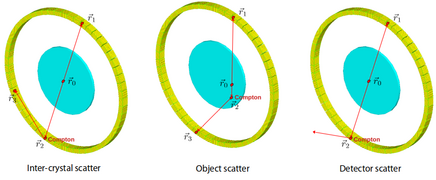
Different Compton-scatter mediated PET events modeled within the project
Grants
The project is financially supported by the European Union’s Horizon 2024 research and innovation programme under the Marie Skłodowska-Curie grant agreement no. 10120706

Publications
- [ 2026 ]
-
Analytical modeling of inter-crystal scattering in PET with energy information, 2026.
-
Inclusion of Inter-crystal Scattering in PET: Analytical Models and Dedicated Reconstruction, IEEE Transactions on Radiation and Plasma Medical Sciences, 1–1, 2026, DOI: 10.1109/TRPMS.2026.3691192.
- [ BibTeX ]